“Your broken heart will die with you, but the objects will remain” is what La Bola Negra director Javier Ambrossi stated on-stage before the Gala screening. He and co-director Javier Calvo emphasised the importance of wanting to create a physical piece of media you can “almost touch”, justifying why they chose to shoot the film on 35mm and why every element is handcrafted: no CGI, real practical effects. La Bola Negra is a love letter to the craft of making films; it is telling the stories of those in the LGBTQ+ community who never got to tell theirs, their “unfinished loves and lives”.
La Bola Negra (The Black Ball) is based on the unfinished play by Federico García Lorca, in which he only wrote the first four pages before he was assassinated at the start of the Spanish Civil War by Nationalists in 1936. The film is a queer epic, and within it the play is reimagined by Ambrossi and Calvo, getting to decide how it ends. The film intertwines the narratives of three men in different regions of Spain, who we see separately in the years of 1932, 1937 and 2017.
In 1932, Carlos (Milo Quifes) is a young man in a wealthy family who gets ‘black-balled’ by a vote to be a member of a prestigious casino in Granada, with assumptions arising about his sexuality within the community, as well as his own discomfort within himself growing. He has to make a decision about whether to conceal his sexuality to climb the social ladder, or risk it all for a new life too big for him in Granada. Quifes‘ performance perfectly encapsulates that of a young man with a seemingly content life with a heavy weight that burdens him; one that’s difficult to put into words, a feeling many audience members have once had.
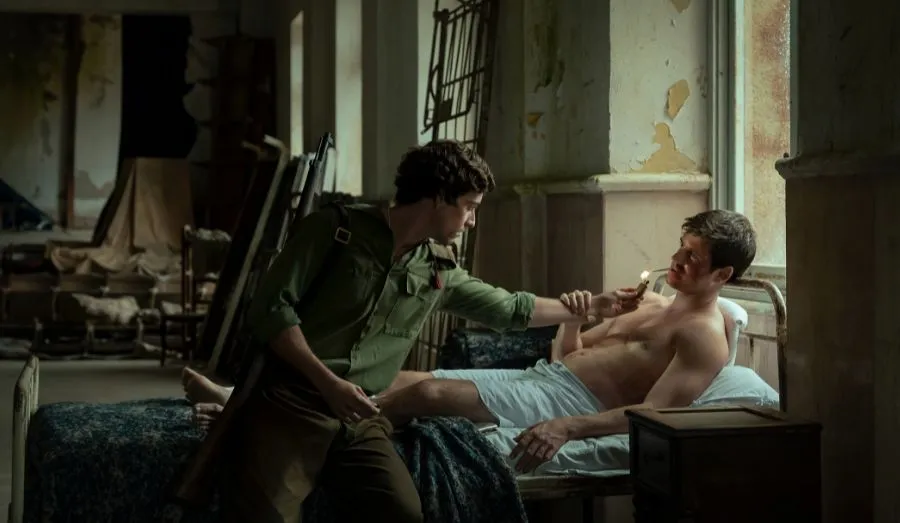
In 1937, we meet Sebastián (Guitarricadelafuente), a trumpeter, whose village is attacked at the height of the Spanish Civil War by Italian aircraft. Even after witnessing mass death, he convinces himself the Italians made a mistake, and flees the village. He is forced to join the Nationalist faction as a guard in order to survive, and is assigned to guard prisoner of war Rafael Rodríguez Rapún (Miguel Bernardeau), who is being healed from injury in order to have sensitive information obtained. Sebastián uncovers feelings for Rafael, who is not only a man but also an enemy; he attempts to make sense of something he never had to think about, whilst also not arousing suspicion amongst his comrades. Guitarricadelafuente’s acting debut is astounding, nuanced expressions only masters of their craft are able to establish, and his chemistry with Bernardeau is subdued with bursts of electricity.
Read More Of Our London Film Festival 2026 Coverage
Finally, in 2017, the audience is introduced to Alberto (Carlos González) in Madrid, a struggling creative who is informed he has been left a will by his grandfather, a man he has never met, who left his mother’s life when she was young, a strong bitterness she still carries with her. The most laughs from the audience came from this narrative; the relatability of a man trying to find his place in society and navigate awkward family interactions he’d much rather avoid. His once stagnant life suddenly seems to become more interesting, finding a sense of purpose along the way, whether he intends to or not.
Visually, the film is flawless, particularly the way the directors manipulate light and shade. There are multiple motifs of small glimmers of light amongst darkness, emphasising an overall message of living in the moment, living authentically, and finding ounces of happiness even if the cards dealt in life are unfavourable.
The score elevated the visual storytelling to the highest degree, particularly in the first half; dramatic string-heavy orchestrations meshing into the modern pop we hear frequently in Alberto’s story. In Carlos’ story, there is a dancing scene with flamenco music in which the camerawork flawlessly transports us into his small piece of respite, the freedom of music and expression, and only adds to Ambrossi and Calvo’s love letter to Spanish culture and history. Many shots are akin to paintings, artwork, burned into our retinas to remember; it is a medium that expands beyond the realm of film and is more akin to an artefact, as the directors intended.
La Bola Negra is a story that needs to be told, seen and heard. There are many people who see it who may not feel safe to come out, scared to live as their authentic selves, battling with self-expression and identity. There is an overall theme of subtlety, small touches, smiles, longing looks. Whatever we choose to do with our lives, whatever we have to do, whether we live another hundred years or die tomorrow, our memories will exist in what we leave behind, our stories told by the communities we found solace in.
★★★★★
In cinemas from November 6th / Guitarricadelafuente, Miguel Bernardeau, Milo Quifes, Carlos González, Penélope Cruz, Glenn Close / Dir: Javier Ambrossi and Javier Calvo / Altitude Films / TBC
