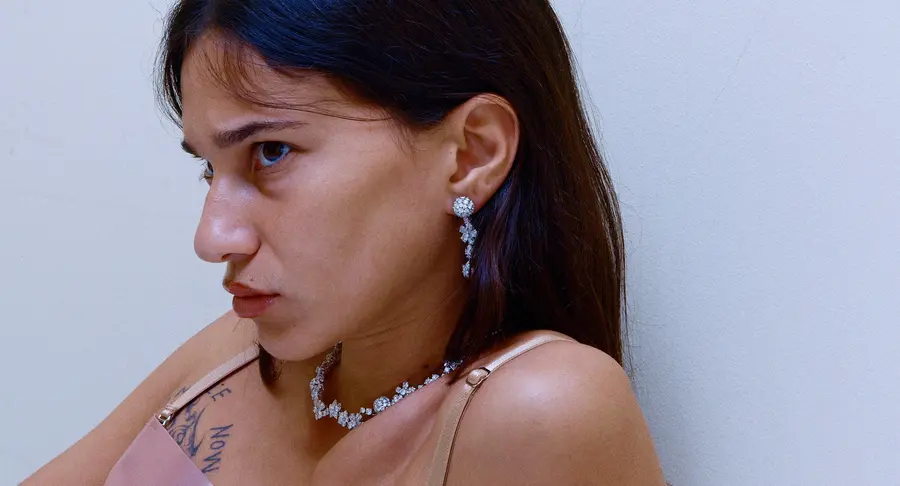
Director-screenwriter Hyun Lee’s French Girls is a micro-budget indie film that takes us behind the curtain of Australia’s fashion modelling industry against the backdrop of late-stage capitalism. It explores the notion of whether you can be yourself in an industry that objectifies human beings as commercial commodities.
French Girls is about 20-something Mia (Mia Kidis), a young blue collar construction worker who is street-scouted into the fashion world for her je ne sais quoi – I don’t know what – that is attributed to her rough edges. A modelling agent tells her that they want her to be herself. “Mia thinks that won’t be too hard, as Mia is herself, so she won’t have to do anything.” A voiceover narrates. The film uses third-person narration. A distinct choice that differs from the traditional first-person narrative structure used in movies where we follow a single character. It makes it so we never really know Mia’s viewpoint as she navigates the opaque world of the fashion industry. Her feelings are as far removed from us as a picture on a billboard or in a magazine.
Read More Of Our London Film Festival 2026 Coverage
This narrative device is acutely aware of the distance between the beholder of an image and the subject of one. It breaks the fourth wall between us, the audience and our relationship with Mia on screen. While we may know some story details about her life, we don’t actually know who she truly is. In effect, this also speaks to the film’s ideas about ownership and control. We can’t expect to know Mia as she isn’t in control of the images of herself. She is a blank canvas on which to sell clothes and jewellery. Her job appears free and easy from the outside. As one character says, “all she does is nothing”, but there is a cost attached to Mia’s work. That cost is the disappearance of personhood and self-identity. A really poignant example was the erasure of one model’s tattoos. In another scene, the same model is subjected to humiliating clown makeup for a photoshoot. Her input was of no value to the designers.
“Maybe the French invented fashion, but they also invented the guillotine. During the French Revolution, French Girls were shooting guns and chopping heads off the bourgeoisie, so why don’t people think of that when they think of French Girls?” – French Girls (2026)
It’s interesting then that Mia’s most defining characteristic in French Girls is the comfort she finds in her camcorder; being the shooter rather than the object of the shoot. She has ownership from behind the lens. This character trait continues the film’s ideas about control, suggesting we only have it when we are the watcher. Something that’s difficult in today’s world, as referenced through Director Hyun Lee’s use of surveillance state imagery in the film. Like Mia, we are all victims of constant observation and scrutiny, especially on social media. Unfortunately, due to the restrictive 28,000 thousand-dollar budget of this film, we only see that oppressive god’s-eye concept in a few scenes, mostly from CCTV cameras, which is unfortunate as it would have been interesting to see that explored further.
“There are four security guards outside this room because the jewellery on this shoot is worth seven hundred thousand dollars” – French Girls (2026)
The film is also a critique of late-stage capitalism. Mia is as much a victim of time theft and dodgy labour practices as the rest of the working world, whilst recognising how glamourised the fashion industry is. There’s an open dialogue about the harsh realities of modelling. Mia, played by Mia Kidis, is a model, which adds to the authenticity of the scene. “It took me like two years to get my first paid shoot”, one model says. Another model adds, “It took me like four.” Then one recounts how he had to spend his own money to fly all the way from Sydney to Paris. With no guarantee of a paid job!
The global fashion industry employs millions of people, and only a tiny fraction of those working as models accumulate a life-changing amount of wealth. The vast majority experience financial instability, lack of labour protections, and intense mental health issues. Especially as they try to stay employable in a turbulent industry where the ‘je ne se quois’ of what’s sellable can change on a dime. There’s a line in the film that perfectly contradicts Mia’s modelling work: “It’s probably easier to be yourself when no one’s looking.” It’s in this line where French Girls makes its most pertinent point: that models can be as much a victim of capitalism as the rest of us.
French Girls’ film form oscillates between docu-fiction and a traditional linear story. The way this creative choice is utilised makes the film an interesting watch, as it broadens our understanding of the fashion industry and recognises how models can be victims of late-stage capitalism just as much as blue-collar workers are.
★★★★
Release Date TBC / Mia Kidis, Anya Beyersdorf, Nash Edgerton / Dir: Hyun Lee / Neon / TBC
