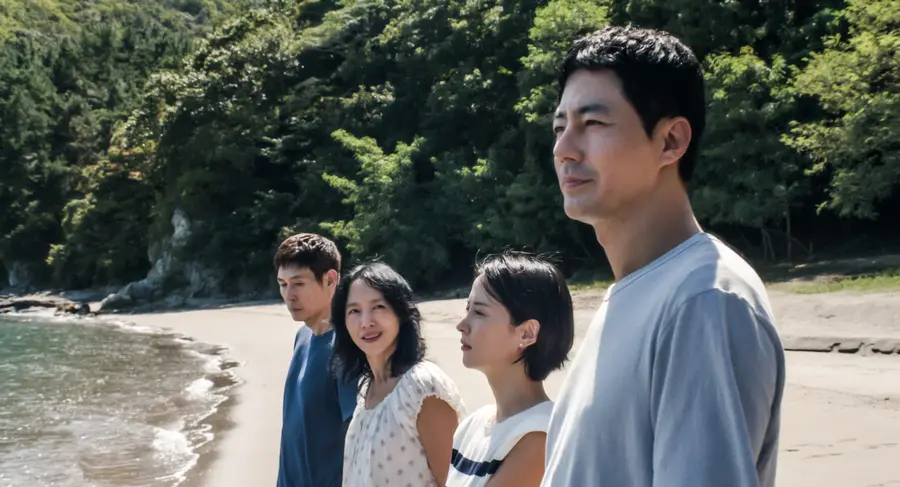
The most effective hook underpinning Possible Love comes down to a funny truth: people are nosy. Possible Love’s rich text on the psychological effects of class disparity suggests a correlation between one’s wealth and one’s insecurity. You spend a lot of time in this film lingering in dejection, festering in a quiet hopelessness, wanting something more. Lee Chang-dong can’t seem to help poking around in the unspoken pain we bear, but that “nosiness” is arguably his biggest strength. His last film Burning was a smartly tense drama magnifying another very real worry; maybe the worst-case scenario could actually happen.
This film asks what us what we’d do with ourselves in that scenario. Mirroring the not-quite-endless cycle of capitalism, the characters put on the same masks over and over, and the entire first half is spent gently beckoning you to slowly scan the faces of two wonderfully performed couples, searching for minute cracks in their presented facades. This effort paid off towards a breathless crescendo of a final act that left me completely floored. It asks a lot of you; by the end, though, you become the one doing the asking. Questions surface that have power far beyond the screen, and it’s that lasting impact that makes the film completely work.
Lee Chang-dong confronted something similar long ago with Peppermint Candy, analysing the modernisation of South Korea and the various disconnections it’s caused among its people. Disconnection exists too, now with much more intimate framing. It’d be reasonable to assume that in the time between Peppermint Candy and now, Chang-dong has seen this film’s central dynamic unfold an exhausting number of times. It’s a quiet, burning pain to feel powerless, and we follow a working-class couple facing exactly that. They become subjects for a documentary about unemployment, poverty, and resistance. The husband (Ho-seok), played solemnly by Sul Kyung-gu, is largely expressionless and subdued for much of the film, recently laid off and still grieving his unsuccessful strike against the company that wronged him. The documentary filmmakers are another much more “successful” couple, unable to relate despite the compassion they appear to have towards the unfairness of the working world. The social dynamics that innately begin to brew here are mesmerising and are ripe for dissection. Within minutes, it becomes immediately obvious how rewarding future viewings have the potential to be.
Read More Of Our London Film Festival 2026 Coverage
I spent a lot of the film waiting. Stuck in a sort of limbo, acutely aware that the film I was watching had faith in me. “Burning” was the same, eventually giving way to a final 30 minutes that re-contextualised everything I’d seen prior, forever haunting my memory of what came before. One of Possible Love’s biggest tricks is similar: its deft ability to take you on a journey without you noticing it’s happening. There are scenes where nothing is technically “going on”, but it’s always in these moments where everything is actually going on. Characters are constantly developing opinions of each other, silently making plans, forming questions, remembering things, forgetting things. It’s easy for any or all of this to slip by you. Always presented with a naturalistic and unassuming patience, very rarely is anything made explicit, and this is what makes the film not just work, but entirely thrive.
Mi-Ok (Jeon Do-yeon) and Ho-seok (Sul Kyung-gu) are unfulfilled. The former wouldn’t dream of showing it, but the latter can’t help but do so. There’s a jealousy brewing in Mi-Ok as she enjoys the splendours of their wealthier counterparts, Sang-woo and Ye-ji (Zo In-sung, Cho Yeo-jeong). The script even describes Sang-woo as a “dream lover”, a nickname given to his younger self by girls who fancied him. Every desire out of reach for Mi-ok and Ho-seok is waiting for Sang-woo and Ye-ji at their doorstep, both in the superficial and the internal. Jealousy gives way to bitterness and resentment. At times this is expressed outwardly and other times it’s subtle, but always present in the air. Brief flashbacks provide some lightness amongst the anguish that usually arises any time Ye-ji places that camera in the room. We see small glimpses of a simpler time where these dynamics didn’t exist, where these people were able to just live with themselves more easily. It was in these moments that I recalled Lee Chang-dong’s extensive background as a novelist.
He didn’t make his name in cinema until his 40s. His earlier career as a literary writer has very evidently informed his approach to screenwriting. Possible Love leaves no stone unturned and is very careful to make sure you’re the one doing the turning. The steady push and pull of when to reveal something to the viewer is ever-present; it’s a careful film. That is until it isn’t, or until it can’t be anymore. I wouldn’t call Possible Love “on the nose” at any moment, but there is an attentively timed outburst in the final act that functions as the lone moment it ever lets the gloves off. It’s riveting and cathartic, and this transparency creates the film’s most human moment. None of this has any meaning without incredible performances, and you’re frequently given scenes with little intel to grasp onto beyond the smallest details on a person’s face. The acting here is thoughtful; each character is given the grace of several dimensions, and that extends beyond the main four. An AA-style meeting Mi-ok & Ho-seok attend at one point allows a few smaller roles to shine, with other attendees sharing stories of how they’ve been laid off. It ends up being one of the most aching scenes, widening the couple’s – and by extension the viewer’s – awareness of South Korea’s turbulent political climate. The most curious inclusion, though, is the son of the family, Cheol (Jeong Seop).
Mi-ok & Ho-seok seem to often forget their son is even around, and so did I. The film feels aware of this, smartly using his quiet observation for one of the best cutaway gags I’ve seen all year: interrupting an awkward, albeit revealing dinner scene. He’s almost an insert for the viewer. Anytime Possible Love reminded me that Cheol is privy to the same conversation I was seeing; it highlighted the absurdity and the sadness of it all. He’s largely unconcerned, quiet, likes to scrunch his face, maybe a bit autistic. The parents don’t appear to know any of this; as far as they’re concerned, there are bigger things at stake. They were a hair’s breadth away from forgetting his birthday, but Cheol exhibits the aloof play that’s naturally inherent in a child and offers a look at the innocence that’s been lost somewhere along the way for our main four. His brief friendship with a housekeeper later on in the film provides one of the more heartwarming tangents, the only adult we see that appears capable of an honest good time.
Possible Love is a dialogue-led experience; any number of lines could brand themselves onto you, but I think the film is eager for you to remember a motif about the “full moon”. I can’t recall the exact phrasing, but Ho-seok likens his ambition to having the “full moon inside him”. This is something he doesn’t feel anymore, associating it now with falling in love, raising a child, landing a job. It’s a feeling we know inside and out, often tied to identity and self-validation, but it’s all too easily forgotten. The four characters we follow show us every side of that coin, and it’s hard to know if Ye-ji or Sang-woo remember this feeling, or just think they do. Maybe they did once, but it eludes them in light of their wealth. There are no binary answers to any of this, but above all, I think Possible Love spends its final shot trying to tell you that you know that feeling too, and you’ll feel it again soon.
★★★★★
In Select Cinemas on October 23rd and on Netflix November 6th / Jeon Do-yeon, Sul Kyung-gu, Zo In-sung, Cho Yeo-jeong / Dir: Lee Chang-dong / Netflix / 15
