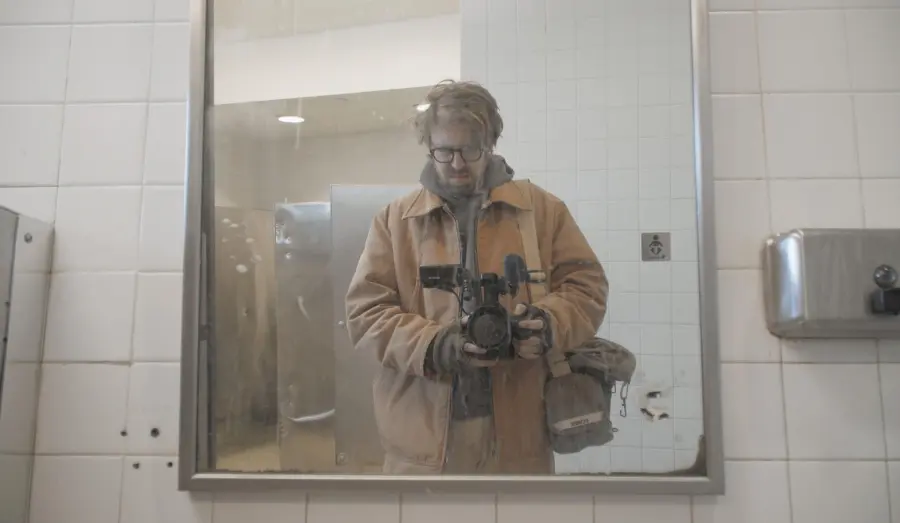
The 2026 BFI London Film Festival was a strong festival. In some ways, I knew it would be, considering some of the enormous names that came to it, like La Bola Negra, Club Kid and The Debut. Something I didn’t expect at all was the number of incredible documentaries that I’d end up seeing. These films present a wide range of subjects and eras, and different approaches to the exploration of their subject matter. I’d love to tell you more about five documentaries I saw during LFF 2026, all of which I think are well worth checking out.
Amazomania (SWE/DEN/FRA, dir. Nathan Grossman)
I don’t think there’ll be another movie this year that’s likely to be as infuriating as this. Amazomania covers documentary filmmaker Erling Söderström‘s obsession with the remote Korubo tribe, starting with footage from his first expedition in 1996 before covering his return almost 30 years later. The initial footage is already bad enough; we start with a solid 5 minutes of Erling and his crew being warned that what they’re doing is a terrible idea. Naturally, they go anyway. Erling goes in on the pretence that he’s attempting to solve a conflict between the tribe and settlers. When he gets there, all he does is point his camera at the tribe and treat them like freak shows, shoving modern conveniences on them for entertainment.
It is morbidly fascinating, and often deeply uncomfortable, to get this insight into Erling’s mind and how little it changes over 30 years. He sees himself as some kind of saviour, even though he’s done sod all to actually help. Even on his return, he’s completely incapable of seeing the damage he’s done, instead trying to weave a woe-is-me tale of how much these trips and films have cost him financially. The film starts in such a way that you wonder if Erling died shooting his initial footage. By the time it ends, you may well wish he had.
Amazomania currently lacks UK distribution.
The History of Concrete (USA, dir. John Wilson)
It didn’t even take 5 minutes for me to realise that I was going to adore this. During the 2023 Writers Guild of America strike, director John Wilson decided to attend a class on how to write a Hallmark movie. He then decided to apply this formula to making a film about concrete. As you do. I went into The History of Concrete expecting a goofy mick-take of the everlasting Hallmark formula, and got so much more than that. In one way, it’s a celebration of art and persisting with it in the face of adversity. It’s also an exploration of how our urban landscapes are changing, and an off-kilter love letter to New York City and the people who make it special. And amongst all that, it somehow manages to be genuinely informative about concrete.
Where I think the film soars is with the depiction of its several weird and wonderful subjects. Wilson could so easily have been mean about them, or framed them as people we should laugh at. Instead, he treats these people with a genuine reverence, reminding an audience primed for ridicule that these people are just like you and I, trying to get by any way they can. Scenes late in the film involving a struggling amateur musician particularly punched me in the gut. I left Concrete having had an absolute blast, while also mourning the loss of the Bed-Stuy Aquarium, and really wondering what the Gumbuster Wine tastes like!
The History of Concrete releases in UK cinemas on January 8th 2027, courtesy of Conic Films.
Read More Of Our London Film Festival 2026 Coverage
Tutu (UK/South Africa, dir. Sam Pollard)
Whether you know a lot about Archbishop Desmond Tutu, or hardly anything, there’s something for everyone in this moving portrait of his life and work. Tutu dedicates the bulk of its runtime to the fight against Apartheid, and the role Tutu played both during and after. Pollard takes an approach to this that I found particularly fascinating, and that I reckon Tutu himself would have approved of.
The film acknowledges how significant his role was, and how deeply his work has touched so many people, but never deifies him. It is keen to state that he was just one figure in a much wider movement, and even pays considerable attention to the impact some individuals (particularly his wife) had on his personal life. We are also treated throughout to never-before-seen footage from Tutu‘s later life, and it is heartening to see just how much joy he was surrounded by in these years. There’s a scene with him renewing his wedding vows that particularly got me!
Tutu releases in UK cinemas on December 11th, courtesy of Dogwoof Pictures.
The Match (Argentina/Spain, dirs. Juan Cabral and Santiago Franco)
The 1986 World Cup quarter-final between England and Argentina is one of the most controversial football games in history. Plenty of English people are still pretty pissed off about it! The match is most remembered for Diego Maradona scoring a goal with “the hand of God”. However, its story goes well beyond one dodgy goal.
The film is an enlightening exploration of everything that led to that match being as contentious as it was. There are plenty of widely known factors, the most obvious of which being the Falklands War. On the other hand, I had no idea how much prior matches between the two countries had contributed to the footballing world, like the creation of the red and yellow card! Cabral and Franco present the footballing side in a way that’s very focused on technique while still being accessible to those who know next to nothing about it. Guilty as charged. The film’s presentation of the match itself is also incredibly tense and exciting. I went in knowing the final score, and still sat there wondering about the missed opportunities, and what could have been. That might just be the good old-fashioned English delusion speaking, though.
The Match releases in UK cinemas on November 20th, courtesy of Disney.
Once Upon a Time in Harlem (USA, dirs. William and David Greaves)
This film was 54 years in the making, with William Greaves shooting the footage for it in 1972. Following his death in 2014, his son David revisited the footage and completed the film. William invited several key figures of the Harlem Renaissance to Duke Ellington’s apartment. He then perched in a corner with a camera and a microphone and let them tell the story of the Renaissance in their own words. The end result is thoroughly informative and nothing short of an absolute joy.
It is truly engrossing to hear these people talk about this movement and learn how much they contributed to art. Greaves’ hands-off approach lets the subjects dictate the narrative rather than there being a predetermined one. The sheer number of people present at this party means you get an unending number of perspectives. Each person has their own figure they wish to talk more about, and several of them end up having prolonged debates, all interspersed with music, photography and other beautiful art. A particular scene in the beginning, combining the photography of James Van Der Zee with him playing a piano tune, really stuck with me. The film runs for an hour and 40 minutes, and I genuinely could have spent all day watching these icons.
Once Upon a Time in Harlem currently lacks UK distribution.
