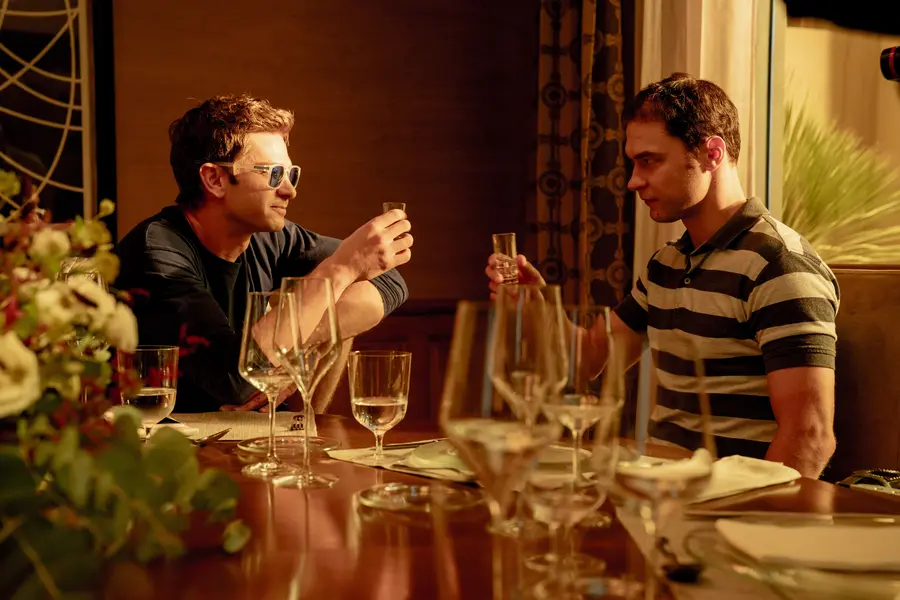
Looking at the films of Luca Guadagnino, it’s fair to say he’s not the first person you’d have in mind to helm a spiritual successor to David Fincher’s The Social Network. The director, best known for his steamy and unconventional romantic dramas, admitted at the film’s London premiere that Silicon Valley isn’t exactly the sexiest place to set a film, but through his lens the founding of OpenAI is a story of seduction, deception and harrowing consequences.
Whilst Andrew Garfield sits at top billing for his portrayal of Sam Altman, it’s Yura Borisov as Ilya Sutskever who serves as the film’s protagonist. Ilya is the idealistic but socially inelegant engineer who cracks the code on artificial general intelligence, and as an outsider he serves as our guide through the treacherous world of tech start-ups and CEOs.
Garfield and Borisov are a terrific two-hander on screen, their awkward chemistry the closest the film truly comes to romance. Ilya likens himself to Pinocchio, an idealistic boy who physically cannot lie, while Altman is manipulative and nonconfrontational at his core, agreeing with whoever shares their concerns before completely disregarding them. In his pursuit of dominance, Altman increasingly acts as a devil on Ilya’s shoulder, affirming his loyalty to the ‘research, safety, rigour’ mantra of the company while skirting the safety regulations he’s so desperately urged to implement.
“Prometheus wasn’t, like, afraid of fire”, says Altman in one of the film’s many hints towards his true nature, a flippant opportunist with a vision too grand to be constrained by morals or safety regulations. He’s a fascinating character, played wonderfully by Garfield; never outwardly menacing or aggressive, but with a sort of deadness behind his uncannily blue eyes that becomes more unsettling the further he descends into Bond villainy. The film repeatedly returns to Altman’s view of humanity’s problems as “bottlenecks”, simply as errors in the code that can be easily debugged.
Ike Baranholtz’ Elon Musk is another highlight, and each time he bursts through the door like Seinfeld’s Kramer, he shifts the tone so drastically you almost anticipate a laugh track. He makes little attempt to mimic the real-life CEO’s accent or inflection, but his facial expressions and mannerisms are unmistakable here. Musk is somehow still the most charismatic character in the film, and the socially stunted developers he surrounds himself with venerate him like a god, his shadow hanging over every interaction he’s not present for. Monica Barbaro lends the film one of its more sympathetic figures as Mira Murati, an ex-Tesla employee disillusioned by Musk’s impatience with safety regulations. Musk’s intermittent appearances in the film as a primary investor in OpenAI are punctuated with assertions that he’s “not going to wait”.
Read More Of Our London Film Festival 2026 Coverage
Guadagnino injects plenty of style to make up for the sterile surroundings, alternating between methodical tracking shots and confrontational close-ups to create a visual language that at once unsettles the audience and invites them to revel in the excesses of its characters. Reuniting with his After the Hunt cinematographer Malik Hassan Sayeed, the pair make great use of the canted angles and ominous fog that characterise the San Francisco cityscape.
Blur and Gorillaz frontman Damon Albarn provides the heartbeat of the film, putting together a score and original songs which often wouldn’t feel out of place in a horror project. Echoing back to Trent Reznor and Atticus Ross’ unlikely success in their first film score on The Social Network, propulsive electronic tracks are met with orchestral pieces that accentuate the drama and tension the film’s characters are unwilling or unable to vocalise.
2001: A Space Odyssey is a recurring touchpoint throughout the film, its poster looming large over boardroom meetings and several characters asking if this new technology could go the same way as the film’s rogue AI, HAL-9000. For students of the humanities and philosophy, the idea of an artificial intelligence more advanced than the human brain is familiar and terrifying, but the developers within the film are focused solely on technology and progress, never stopping to see the warning signs until it’s too late.
Artificial came to be when screenwriter Simon Rich spoke to a friend and employee of OpenAI about the very real threat posed by artificial general intelligence. In typical Guadagnino fashion, it became a story of personal seduction and betrayal, but the film never loses track of the bigger picture and the pervasive danger we face when technologies like these go unchecked- in the words of a whistleblower who confronts Ilya towards the film’s climax: “The question isn’t how could this go wrong; it’s how could it not?”.
★★★★
In cinemas from January 22nd 2027 / Andrew Garfield, Yura Borisov, Monica Barbaro, Ike Barinjoltz, Cooper Hoffman, Jason Schwartzman, Chris O’Dowd, Mark Rylance / Dir: Luca Guadagnino / NEON / TBC
