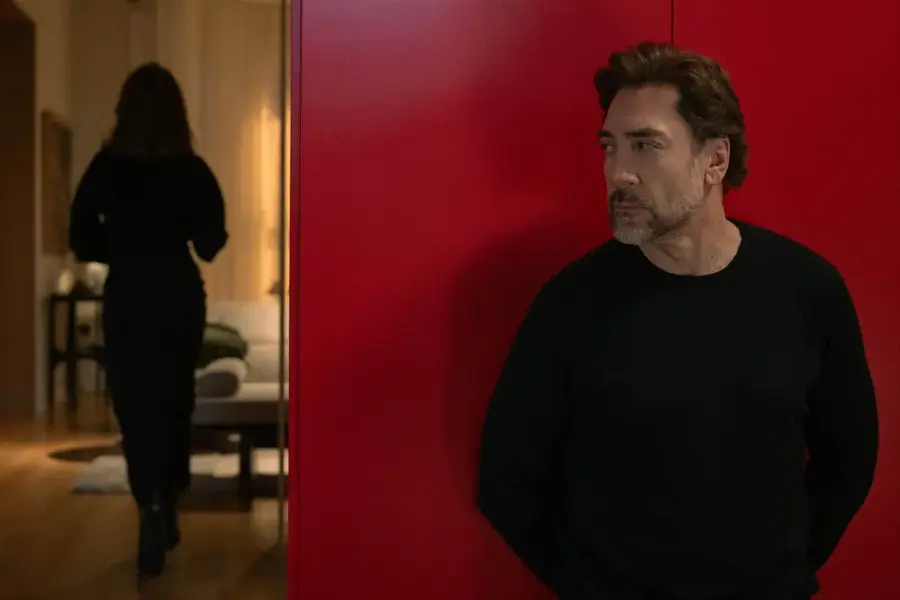
There’s a meta-textual reading here somewhere as Florian Zeller continues to struggle following up his remarkably assured debut film, The Father. Bunker is itself hiding in its own bunker. Behind skin-deep satire, behind non-sequitur subplots, behind the key jangling of tension and worldwide panic. In retrospect, it reads like an attempt to mask its lack of identity, as the film never finds a distinct rhythm across its tedious 2 hours.
We start with a dinner table meet-cute story at some elegant, shimmering restaurant, and our two leads squirm around their inability to hide. There’s no bunker that can obscure how visibly bothered Sofia (Penelope Cruz) is, or how blinded Miguel (Javier Bardem) is by his desperation to put on a show for his hungry listeners. There’s something brewing in the subtext, but as the film proceeds, this subtext gradually begins to awkwardly merge with the text. The repeated motif of a hammer crudely smashing down a wall ends up ironically becoming a prescient metaphor for how it feels to watch. It’s a film that I found funny sometimes, by accident? Maybe, it’s hard to tell. Primarily, I left the film feeling as if it was an aimless waste of my time and unconfident that anyone I saw on my screen fully understood what film they were a part of.
I can count at least three stories unfolding that are duking it out for the title of ‘main plot’. There’s a lucrative job Miguel is tempted by despite his supposed ideological disagreements with the work, there’s his crumbling relationship with Sofia, and then there’s the Bunker of it all. Not-so-friendly neighbour Toby (Stephen Graham) wants to turn a shed into a studio; the only problem is this shed belongs to our leading couple, and they’re not a fan of the idea. This doesn’t stop him from pressing on with it, playing the victim and making implicitly threatening suggestions. You’ll occasionally have your film interrupted by 30 seconds of Miguel and Toby butting heads, racial tension being the angle lurking underneath as Toby feels entitled to the property of an immigrant couple. This, by itself, may be a compelling story worth telling in a different film, with someone different at the helm. As it stands here, I didn’t glean that the film had anything to say about this. So why include it? Especially when eventually, Toby is depicted as a bit of an unsung hero with an embarrassingly cheap & smug ‘never judge a book by its cover’ twist finale.
Graham performs with this cold, thuggish demeanour that is completely one-note and feels like it belongs in another film entirely. Paul Dano and Patrick Schwarzenegger show up as well to play a few caricatures of their own. Dano does a loose riff on Elon Musk? Mark Zuckerberg? It’s hard to nail it down. Schwarzenegger is playing this film’s idea of a profound, existential author that Sofia is enticed by. These characters can offer a break from Sofia & Miguel’s endlessly wheel-spinning marital exchanges and reinforce the worldwide panic the film may want to raise your awareness about; it can’t seem to decide. Dano’s ‘Andrew’ needs Miguel’s architectural skills to build the highly advanced bunker he wants with his billions of dollars. During their one conversation, Miguel scrapes the bottom of the barrel looking for some kind of justification for why one would want, or need, a bunker so that he can take the money and still be able to live with himself, or, more importantly, his other half, Sofia. Again though, does the film really have anything to say about this? If it does, it got so lost and covered in the muck that I can’t make it out anymore. It’s the lack of harmony between these intertwining stories that ends up being the defining characteristic, for better or worse.
Read More Of Our London Film Festival 2026 Coverage
I laughed quite a lot throughout, more than I was supposed to, but it’s hard to measure what is and isn’t a joke. My first dead giveaway that something was off about how this film moves came in the form of an exclusive private meeting where Miguel is asked to sign an NDA about this billion-dollar bunker deal he’s been offered. It opens with a shot of three equally spaced suited businessmen with smarmy, villainous smiles. They write down a note detailing the offer and pass it to each other twice before passing it to Miguel. My mind immediately darted to a comedy sketch idea, where the joke is that they keep passing this note to each other again and again for ages. Teasing the feeling of finally handing it over but never doing it, I think this bit wouldn’t feel that out of place in the film and in my mind that’s a problem. There was an awkwardness in the air for a lot of this runtime, and it made it nearly impossible to tell if what I was seeing was supposed to be as goofy as I was finding it, or if it’s really expecting to sell me on this being a tense encounter. My biggest laugh came from a security technician played by Robert Wilfort, though. He arrives for one scene only to introduce to the now paranoid Miguel a fancy new security system that involves huge plumes of smoke engulfing the intruder. There’s an inherent level of slapstick to this already, but on top of that the technician goes on to relay all this information with a staggering amount of British pep, like I’d switched channels to Only Fools & Horses for a moment. It gave me a few moments of fun, but then I exited that fun to be accosted by a film that wants to make sure I’m acutely aware of how disconnected we all are, how frightened we should be (for some reason).
There are two daughter characters and a missing cat too. The cat is introduced near the start of the film, but when this happened, the placement of it in the frame and the (admittedly not awful) CGI work led me to interpret the cat as an ornament on Miguel’s desk rather than a living, breathing household pet. This ended up being the first of a few technical hiccups; I found it distracting how YouTube videos or Zoom calls looked. Bizarrely high quality and unnatural. Music often sanitising any moment of meaningful quiet. Either way, I think forgetting about the cat entirely would actually benefit this film. It’s hard not to read these characters as more than disposable devices, or the film clawing at anything it can to try and invest you. An estranged daughter or a missing cat reads all too easily as manipulative fodder long before anything one could feasibly attach themselves to when none of it ever feels in service of a vision. The older of the two daughters has extremely minimal dialogue since she just can’t pry herself away from her phone, causing more worry and points of contention for our leading couple. Again, an arc that feels predictable, arbitrary and present only for the purpose of inspiring Miguel to think about the plausibility of actually building these bunkers he keeps hearing about. The connecting threads keeping all of this relevant to the underpinning failing marriage are frustratingly transparent, but most importantly, complete filler. Filling in gaps that the very capable actors helming this story could easily fill.
The most damning thing I can say about Bunker is that it didn’t really leave me thinking of anything, other than the unanswered question of why it was made. I never felt that this film was a product of burning desire or passion; it’s far too comfortable spinning its wheels to ever reach that connection. Seemingly desperate to generate any kind of stakes, it does go for one final swing in the last 15 minutes by introducing something of a set piece, but the tension remains non-existent. Too little, too late, screaming into the void but without any of the catharsis, or any of the screaming.
★★
In cinemas from January 22nd 2027 / Penélope Cruz, Javier Bardem, Stephen Graham, Paul Dano, Patrick Schwarzenegger. / Dir: Florian Zeller / StudioCanal / TBC
