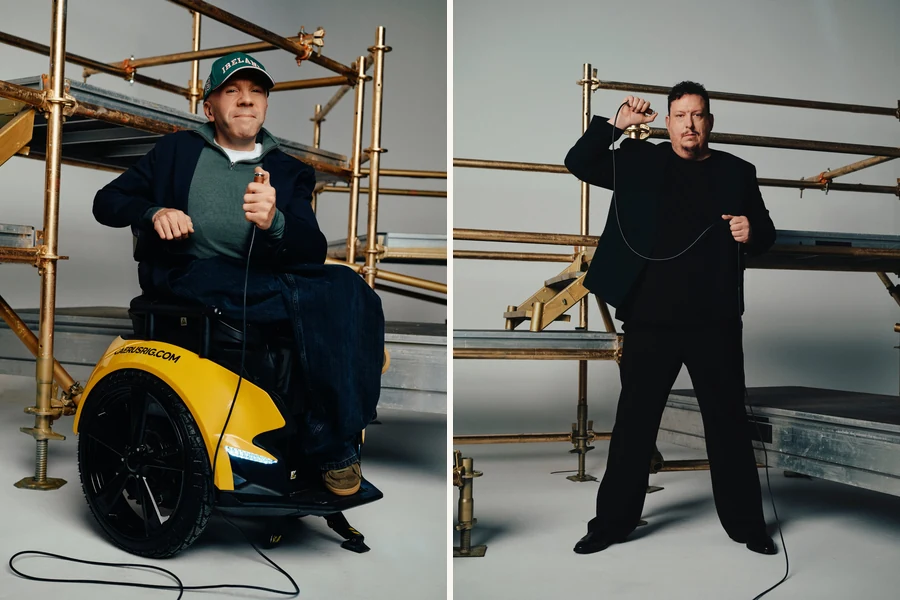
Chris Lynch is the disabled filmmaker behind In the Driving Seat. Ted Evans is the Deaf writer-director behind Retreat. Both have been selected for this year’s BAFTA Breakthrough cohort, and what was clear from our chats with them ahead of the announcement is that an accessible filmmaking undoubtedly makes for a better set.
It’s a message the industry still badly needs to hear: disabled people made up just 10.9% of off-screen contributions in UK TV, according to the Creative Diversity Network’s latest report. In this deep dive, we look at why Chris and Ted believe accessible filmmaking makes for better filmmaking, and what everyone stands to gain when sets are open to all.
We first spoke to Chris, the presenter and producer of In the Driving Seat, a BBC Northern Ireland documentary exploring cutting-edge mobility technology, inclusive design and the future of wheelchairs. Chris, who has brittle bone disease, has spent years developing CAERUS, which he describes as the world’s first wheelchair-integrated professional camera system. The idea came from frustration: he had “always been restricted in terms of what I could physically manage”, yet what he loved was “camera operating and being a creative”.
The technology allowed him to take on a “multi-layer role of both producing it and presenting and shooting” the documentary, and that mattered beyond his own career. “It was really important for me to be able to then use that as a showcase,” he says, “to demonstrate to others that this is possible.”
Chris tells us that young people have told him “time and time again that… they’re told they can’t [do] their role because of their disability… they’re funnelled into something that they don’t want to end up doing.”
Read More Deep Dives
“I’m really pushing back on that,” he says. His answer is what he calls “inclusive technology, inclusive production”: taking tools that already exist and using them in new ways, such as training people to use a drone in place of a technocrane to get the shot. As he puts it, “there’s a wealth of technology at our disposal, but people just don’t have the ability to join the dots.”
We then spoke to Ted Evans, writer-director of Retreat, billed as the world’s first Deaf thriller and starring fellow BAFTA Breakthrough participant Sophie Stone. Like Chris, Ted designs his productions with access in mind, and hopes it can change how films are made.
As Ted explains, a deaf actor is usually the only deaf person on a production, with an interpreter assigned to them the whole time. With an all-deaf lead cast, Retreat needed a different approach. “We assigned an interpreter to every HOD [head of department], so make-up, costume… so that no matter where they moved on set… there would always be someone there to make it accessible. Interpreters aren’t just for deaf people; they’re also for hearing talent who aren’t able to sign. Our producers went to great lengths to make this such an equal and inclusive environment for everyone.”
According to Filming in England, that meant 12 to 14 interpreters on set each day, booked six months in advance. The whole crew received deaf awareness training with basic BSL, and extra shooting time was built in because communication takes longer. As the film’s producers put it: “time is an access requirement.”
For Ted, though, access is about more than logistics. He believes “sign language has so much to contribute to cinema,” and sees it as “very akin to dance or combat”. “With sign language, it’s purely visual. Once you film it, that’s all there is… you can’t really fix it in post. As a filmmaker, you have to think much more in pictures… You have to really, really think about the edit.”
It echoes Chris’s ambitions for CAERUS. He has said he wants the system judged “through a creative lens” rather than as a charitable gesture. For both of them, accessible filmmaking isn’t a box to tick. It’s an untapped creative opportunity.
That push for change is also why BAFTA Breakthrough matters so much to them. “If you’re in a position where you’re slightly disadvantaged, as I am, in terms of having a disability… there are so many more barriers,” Chris says. “So having this opportunity to connect with people in this way is just amazing.”
For Ted, who grew up watching the BAFTA Awards on TV, the recognition is still sinking in, made all the more special by being selected alongside his lead actor, Sophie Stone.
The access these two are building isn’t just for themselves, but for the next generation coming through. And Ted’s advice to deaf filmmakers hoping to follow them is simple: “Don’t wait for permission. Just make films and build from there.”
The 2026 BAFTA Breakthrough programme is supported by Netflix.