Contains spoilers for WandaVision, Agatha All Along and VisionQuest
It is not far-fetched to assume that the Marvel Cinematic Universe has long been associated with blockbusters, action-packed battles and the age-old fight between good and bad, yet interwoven into all of their stories lies something deeper: real life.
It is their first trilogy of Disney+ television series that takes these moral dilemmas one step further. WandaVision (2021), Agatha All Along (2024) and VisionQuest (2026) highlight something never done before in the MCU. In the shows’ interlinked explorations of love and grief, it becomes clear that your favourite characters may be capable of transcending the boundaries of human existence, but no amount of power can be strong enough to cope with the very real and human experience of loss.
These three series offer different perspectives surrounding the same emotional territory, with one reoccurring question being what does it mean to love someone who is no longer there?
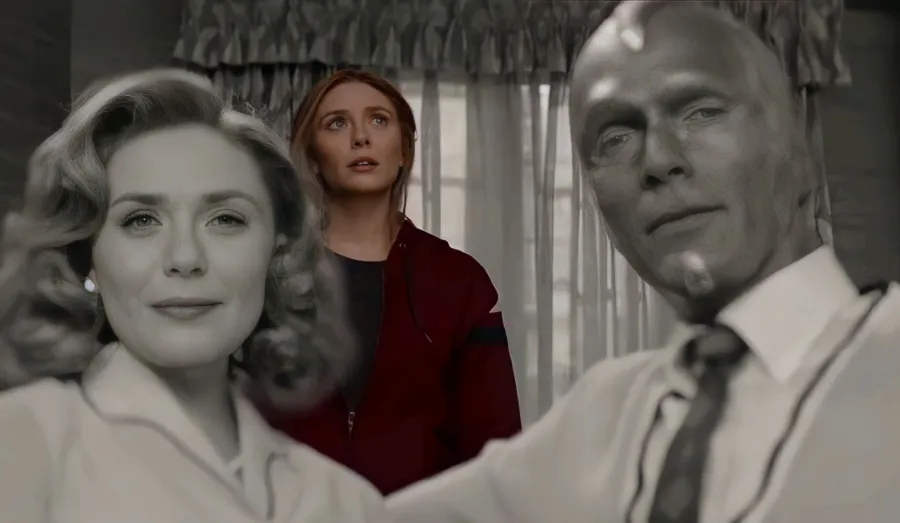
For Wanda Maximoff (Elizabeth Olsen), the answer appears obvious: refuse to accept their absence. In Westview, grief becomes something easily manipulated and rewritten to offer escape. A suburban home replaces the battlefield, a marriage becomes a sitcom, and a dead man (who is actually a synthetic life form) is brought back to life because Wanda cannot bear the alternative. But beneath the nostalgic television aesthetics and domestic comedy I first believed the show to be, WandaVision tells a much darker story about the relationship between love and loss.
WandaVision’s director, Matt Shakman and showrunner, Jac Schaeffer, revealed to Los Angeles Times that the show uses Kübler-Ross’ five stages of grief as a narrative framework. In the wake of Avengers: Infinity War, Wanda hexes the town of Westview to create an illusion of her fantasies. This clear example of denial offers an escape from the reality of losing the love of her life, Vision (Paul Bettany). Instead of facing reality, her magic can conjure up the complacency of an entire town to fit the life – and family – she has always dreamed of.
The series uses inspiration from American sitcoms belonging to different eras, and these domestic settings are important in representing the life that Wanda has repeatedly been denied from having. The episodic changes in television aesthetics reflect both her psychological state – anger, bargaining, depression – and her desire to maintain this fragile illusion of happiness.
But it is those affected by Wanda’s grief that help us to explore an important consequence of the emotion: at what point does the preservation of love become an act of selfishness? Whilst Wanda experiences Westview as a refuge, its residents are trapped inside of her grief and forced to suppress their autonomy and participate in a life they never chose. For Wanda to have her own children and her own husband, the residents of Westview have to forgo the lives they once had lived and breathed.
Whilst we want to sympathise with Wanda’s grief, can we excuse her behaviour?
Understanding Wanda’s suffering does not absolve her actions. Her grief is easily recognisable, but her response to it is troubling. The series does well to highlight this as it follows Wanda on her journey through grief until she reaches acceptance. The series’ most confrontational moment is not a battle between superheroes; it is Wanda’s farewell to Vision. The Vision himself reminds Wanda, “What is grief, if not love perservering?” Through the recognition that Vision was her sadness and her hope, she realises that love can transcend death, and that hurting others is not right despite her own hurt. She accepts that no level of power can defy the love she had once felt for Vision and willingly forgoes the faux-family her magic has created out of grief.
Accepting death doesn’t diminish the love you shared, as Wanda comes to realise, but what happens when someone is incapable of reaching that solution?
Agatha All Along helps us to answer just that. Introduced as the nosy neighbour slash antagonist in WandaVision, Agatha Harkness (Kathryn Hahn), a centuries-old, infamous witch who siphons magic from others, brings a new perspective to the relationship between love and loss. Whilst Wanda’s grief is spectacular and obtuse, Agatha hides her own beneath an armoured personality. Through her dark humour and manipulative ways, you begin to question whether she is even capable of experiencing love, until you discover that she had, and lost, a young son.
Another layer of complexity is added through the revelation that Agatha’s past lover, Rio, is Death. Unlike other characters, her connection to death is not merely theoretical; it is intimate, personal and deeply painful. She has lived with the knowledge that someone she once loved took her own child from her. We can assume there was a time when she had been trusting and vulnerable with Rio, only to experience a life-altering betrayal born from her vulnerability in letting herself love.
Agatha’s personality can, partly, be understood as a form of emotional protection. Whilst Wanda works to recreate what she has lost, Agatha builds an identity around avoiding the vulnerability that loss creates. Her sarcasm and cruelty become her way of maintaining control over relationships that threaten to expose her feelings.
Read More Deep Dives
Unlike Wanda, who is trapped in her grief, Agatha runs from it. She buries herself in a facade of control and power, that is until Billy Maximoff (Joe Locke) entraps her on the Witches Road and leaves her forced to confront what she has been running from: that there is no one to blame for Nicholas’s death, including herself. In a heart-wrenching scene towards the show’s finale, Agatha is stripped bare of her emotional guard and cries as she realises that “sometimes, boys die.”
I first inferred that Agatha is an example of somebody incapable of reaching acceptance, and I believe the final confrontation of the series between Agatha and Rio proves exactly why. When Agatha kisses Rio, it appears to be a heroic attempt to save Billy and sacrifice herself; however, we later learn that Agatha evades death and becomes a ghost. Her plan to return diminishes the act of sacrifice, and therefore, I see this kiss as an act of reconciliation. It is an apology for all the years she spent turning love into blame and a recognition that Rio didn’t just take from her, but she gave too.
In VisionQuest, a new form of bereavement is explored: the loss of identity. Following the events of WandaVision, Vision’s reconstructed form possesses memories from the original Vision’s existence, but he lacks any emotional connection to them. This lack of meaningful connection leaves Vision to experience great turmoil.
The show raises fundamental questions about identity and its relationship with change. The philosophical thought experiment, the Ship of Theseus, asks: when something changes piece by piece, at what point does it become something else? Vision presents a more emotionally complicated version: if physicality and memories survive, but emotional connections are lost, does the same person remain?
Vision’s connection to Wanda is important; their relationship helped to define his understanding of love, belonging and what it meant to be human. It becomes clear in VisionQuest that remembering the relationship is not the same as inhabiting it emotionally, and rather than grieving the loss of Wanda, Vision grieves the loss of the person that Wanda believed would always love her. Though he claims to feel nothing, it becomes clear that Vision experiences guilt and grief, just not in the way he believes he should.
His developing relationship with his son, Thomas (Ruaridh Mollica), adds another interesting dimension: can family and connection be understood by something other than biology or personal history? Vision begins by denouncing himself as Thomas’s real father because he believes he is not the same man present in Thomas’ memories, but through their shared search for answers and mutual understanding of being in new bodies, Vision is challenged to reconsider what makes a relationship meaningful. Referring back to the Ship of Theseus, it becomes clear by the series finale that, though Vision and Thomas are both changed, they will always remain father and son. As Wanda says in the finale of WandaVision, “family is forever.”
The series culminates with Vision realising that his lack of emotion and connection to his memories is because he refuses to acknowledge that, by letting himself reconnect, it would mean experiencing the profound grief of realising that he has lost his family. Like Wanda, and like Agatha, Vision is avoidant in accepting the truth.
I find it poignant that an artificial being was used to explore such recognisably human anxieties. Through Vision’s struggle, it is suggested that identity is not something simply inherited from our past, but something we continue to construct through our relationships and choices. There is a beautiful moment that follows Vision’s newfound acceptance. Whilst Ultron proclaims that “grief isn’t love, it’s fear,” we are offered a glimpse into Vision’s emotional growth when he responds, “Yes, you’re right. It’s fear. Fear that without them you’re no one. Inconsequential. An untethered thing that can all too easily float away and disappear. Alone.”
This trilogy offers differing perspectives on one fundamental problem: our desire to control what cannot be controlled. Wanda avoids her loss by reconstructing her reality. Agatha opts for manipulation and emotional distance to protect herself from the pain of the past. Vision is forced to consider the relationship between memory, identity and the possibility of becoming a changed man. Their stories suggest that grief is not simply about losing someone; it can also mean losing a version of ourselves.
For me, the most interesting aspect of this exploration is that these characters possess exceptional power and ability, yet remain unable to escape the emotional consequences of loss. Whilst magic can reshape reality, power can manipulate relationships, and technology can preserve memory, none of these things guarantee that love can remain unchanged.
The most relatable experience that these extraordinary characters provide the audience with is not how to defeat death, or how to preserve the past, but how we can continue to live when love does not prevent loss.
The WandaVision trilogy is currently streaming on Disney+
