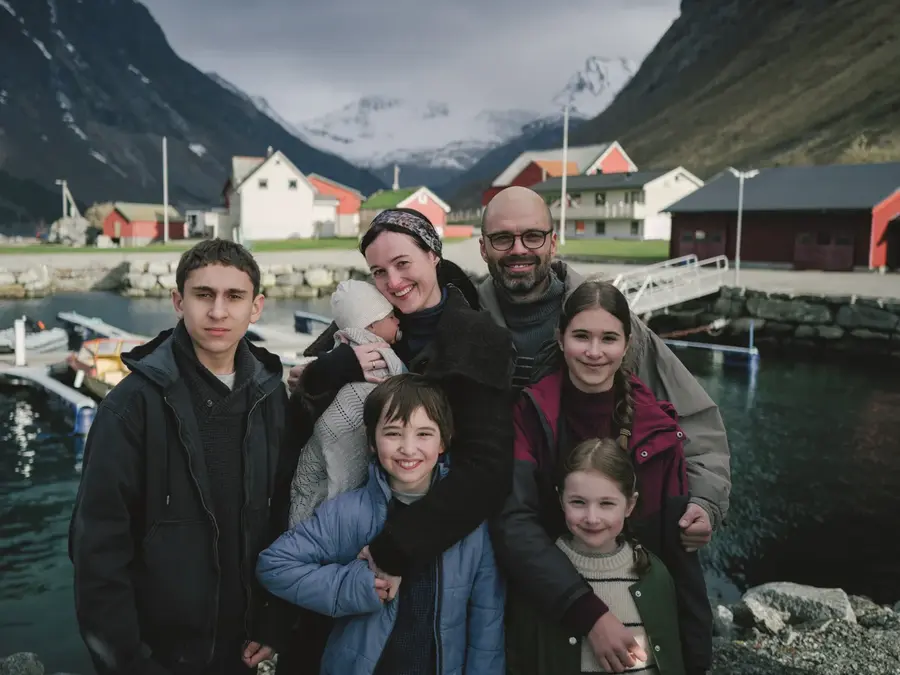
At the gala screening of Fjord, Director Cristian Mungiu wanted to make it clear that this film isn’t his way of preaching; he wanted to make “an arthouse film that’s entertaining too”. He likes to take the material of everyday life, rather than writing stories from scratch, and allow the audience to find answers about their own lives. Fjord in itself is a grey area; lines are blurred between morality and law, personal values and human rights.
Fjord follows the Gheorghiu family: parents Mihai (Sebastian Stan) and Lisbet (Renate Reinsve), along with their five children, attempt to settle into a new life in Norway from Romania, where they moved to be closer to Lisbet’s family. The family are devout evangelical Christians, which gradually becomes a point of contention with the town they inhabit and its agnostic ethos. Not long into the film’s runtime, flags are raised by Elia (Vanessa Ceban) and Emmanuel’s (Jonathan Ciprian Breazu) teachers, who discover bruises on Elia’s face and back, along with off-the-record comments about their parents’ methods of discipline. With Norway’s incredibly progressive child-protective services becoming involved almost immediately, the main conflict of Fjord is set out from the get-go: where is the line drawn between culture and abuse? Religious ideals being punished with the most severe legal repercussions?
Read More Of Our London Film Festival 2026 Coverage
Closeness and family are core themes; both emotionally and physically, the Gheorghius ‘ new town is a place where everyone knows everyone, a civilisation that’s impossible to keep secrets from. The children’s headteacher, Mats (Markus Tønseth), living just two houses away from the Gheorghius, their lives very quickly and forcibly intersect. Elia and Emmanuel also grow close to their headteacher’s teenage daughter Noora (Henrikke Lund-Olsen), an impulsive, free-spirited girl with her own antisocial and rebellious concerns. Despite the Gheorghius living incredibly polarising lives, Noora can’t help but be drawn to them; they become reliant (perhaps almost too much so) on each other, an intersection of the two cultures becoming an unexpected emotional glue as we follow their stories.
The location of Fjord does much heavy lifting for the cinematography overall; it is filmed in Hjørundfjorden, Western Norway, where stunning fjords are surrounded by huge mountain peaks. It is needless to say how striking it is visually; each shot of the landscape feels like a painting. When discussing the importance of the film’s setting, Mungiu metaphorises it as our “fragile world”, with the stillness of the water and the snow lying atop the mountains, which within the film regularly causes minor avalanches as it tumbles down. The setting reflects the overall tone of Fjord, calm yet sublime, a plot that is relatively simple yet so profound it is difficult for one to uncover in one sitting. The fjords are frequently in the background of shots of homes and professional buildings; such beauty that’s impossible to escape from, it looms in every setting.
It goes without saying Stan and Reinsve’s performances were of the highest level; no dramatic monologues, but instead quietly stressed performances of two parents attempting to navigate their family’s turmoil in a society they have barely gotten used to. Along with Tønseth, their performances stood out in a class of their own, though every other actor’s performance was perfectly competent and certainly didn’t detract from Fjord’s immersion.
Fjord has all the elements of a perfect film: a sublime setting, intricate screenplay, and top actors of their craft. However, on a personal level, there’s something slightly amiss, perhaps the overall message not hitting as profoundly as one may expect from a venture on a scale this grand. Tonally, it felt flat at times, and its 2 hours and 26 minutes runtime was most certainly felt; the first half was paced well and led to something it couldn’t quite reach. However, Mungiu’s vision is incredibly clear, though it may not be to everyone’s taste. Mungiu insisted in his gala speech that he didn’t want to “preach”, and the conversations emerging as everyone exited the screening were far from manufactured; instead of the excited boisterous buzz of a packed-out venue there were instead eloquent murmurings between friends and family.
Fjord is a film that leaves more questions than answers, one that makes you wonder if every other person in the audience is of the same opinion as yours. In fact, Mungiu encouraged everyone in the audience to rewatch the film in the near future, and it’s easy to see why. Fjord has a lot to say, though the way it talks will certainly feel estranging for some.
★★★
UK Release Date TBC / Sebastian Stan, Renate Reinsve, Lisa Carlehed, Lisa Loven Kongsli. / Dir: Cristian Mungiu / Picturehouse Entertainment / TBC
