It is nearly impossible to avoid the conversation and fanfare around You Can See Everything, which first premiered as a secret screening at the 53rd Telluride Film Festival on September 6th 2026, and as someone from the UK, I have waited eagerly for over a month to join in. It is a documentary, but it defies the genre, smothered in smoke and mirrors; everyone at some point is a manipulator or manipulated. It’s an extreme game of cat and mouse, and everyone struggles to hide.
In 2023, Canadian satirical comedian Nathan Fielder and director Lance Oppenheim (recently known for his other A24 venture Primetime) are personally invited into the home of infamous fraudster Elizabeth Holmes and her partner Billy Evans, with whom she shares two young children, to document the 34 days before Holmes is incarcerated for 11 years for defrauding investors. The couple aims to document the ‘true character’ of Holmes, to defy assumptions and expectations. After seeing the film in full, Fielder and Oppenheim’s journey to creating You Can See Everything felt strangely fated; after being friends for years in 2023, Fielder (who dreamed of being a magician in childhood) took Oppenheim to the Magic Castle. Upon being asked for the name of a celebrity by a magician, someone in the group said ‘Elizabeth Holmes,’ which triggered a light switch in Oppenheim’s head. He had heard a rumour that Holmes had reached out to A24 about creating a documentary, and the rest is history.
It’s clear from the outset that Fielder wants to be disruptive; he is best known for his shows Nathan For You, in which he manipulates real businesses by offering increasingly outlandish advice, and The Rehearsal, where he directs ‘rehearsals’ of elaborate scenarios to help people prepare for big moments and every potential outcome. He is a master of mischief and mayhem, doing so with a straight face and monotonous voice; audiences rarely see the real ‘him’. In You Can See Everything, he attempts to turn people against each other, sprinkling questions and ideas to break a circle of trust (ironically, a magician’s term). He is a formidable force, not letting go until physical intervention, but he comes up against an immovable object, or perhaps several. It’s not clear how close to reality the version of Fielder the audience is viewing, or whether he is actually in control of the situation; it’s a compliment to Fielder’s intelligence, perhaps pursuing the idea that documentaries can also be littered with fiction and uncertainty.
Even when the film troughs from its peaks, the tension remaining is uncanny, clinical and terrifying; even just days before Holmes’ incarceration, there is little mention of the elephant in the room between herself and Evans, still attempting to conduct business deals for a so-called ‘Theranos 2.0’. They themselves heavily plaster reality, even after offering Fielder a room in their home in Holmes’ final week of freedom, in an attempt to help him paint an accurate portrait of their family life. An unfathomable situation for most is almost discarded with little sense of urgency; what is meant to be intimate and heartbreaking is more comparable to a business deal, but a few silent tears from Holmes indicate she perhaps is a human after all, deep down. Contextually, Holmes and Evans are master manipulators in their own way; Holmes is able to command a room of powerful investors at the peak of her career, and Evans is attempting to direct and sway conversations between Fielder and everyone else in the room with unexpected force.
Read More Reviews
Trust is a concept that gets redefined; Holmes proclaims her innocence persistently throughout, with those closest to her unravelling her past and character, shining a light on the path which led her to a long prison sentence. A person most famous for lying, now trying to rewrite her story, and unexpectedly, there were points I was inclined to believe her, before crashing myself down to earth that maybe (the word maybe holding a lot of leverage), this is what Fielder wants us to believe all along. We, the audience, are simply pawns in an idea too big for us to comprehend, the truth we can and will never fully know.
Tiny semantics are called into question at many opportunities by everyone being filmed; conversations which, in any other context, appear pedantic to audiences, such as the difference between saying ‘I knew about it’ and ‘I knew about something’, one word disrupting the reality the audiences currently believe. The whiplash of trust and deceit hits hard and fast; it’s unrelenting. Who knows more than they’re letting on? Who is the unreliable narrator? Who is in control?
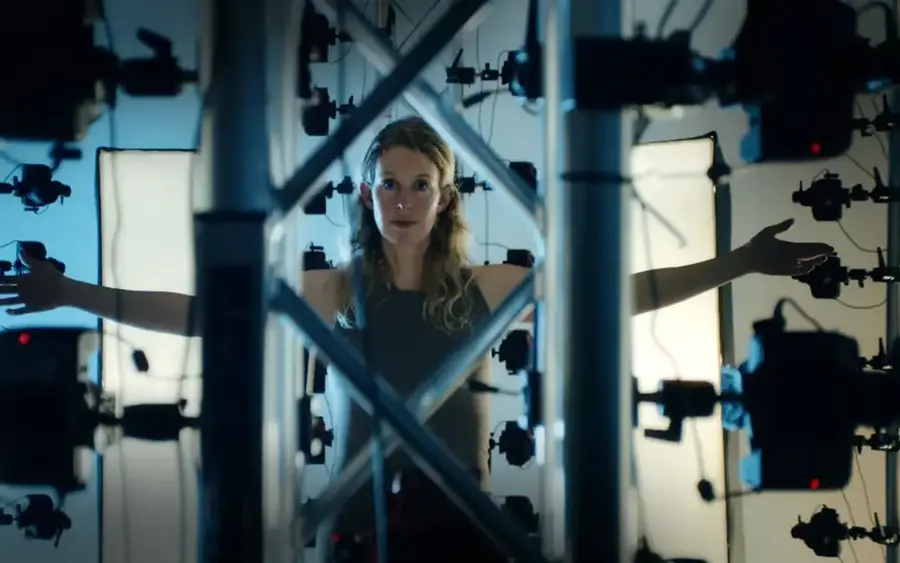
I simply can’t overstate that all the metaphors in the world cannot accurately describe the layers of psychological intricacy You Can See Everything packs into its three-hour runtime, which raced by at lightning speed. It creates an uncomfortable feeling of bewilderment, with the lines of reality and fiction blurred from the outset. It is accompanied by stunning cinematography and blocking; it is a visual spectacle and is difficult to believe the frames weren’t heavily storyboarded (or were they?).
This film is laced with gold, platinum even; it transcends far past the reality of anything in its own genre and is in its own calibre, and what is most fascinating is this was likely not done on purpose. It’s almost impossible to fathom what comes out of people’s mouths unprompted, even with a large boom microphone hanging above them and a camera crew directly infiltrating a small home. I left the theatre speechless, which is a rarity; it feels like the sort of media that needs to be unpacked in group therapy. You Can See Everything is a feast for the eyes and a never-ending nightmare for the brain, and I mean that in the best way possible.
★★★★★
In UK cinemas 20th November / Nathan Fielder, Elizabeth Holmes, Billy Evans / Dir: Lance Oppenheim / A24 / 15