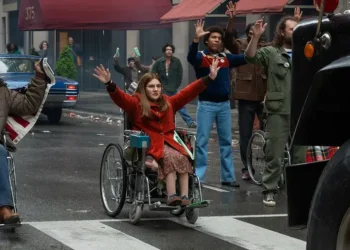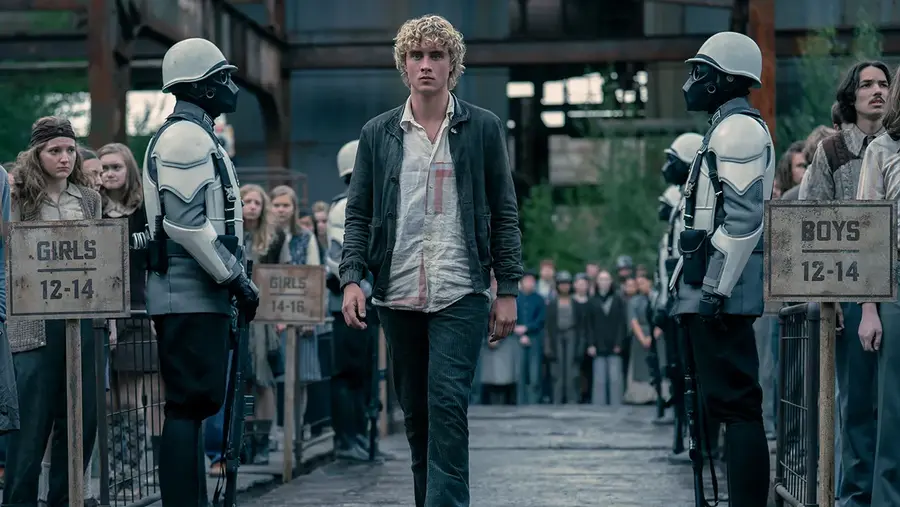
There’s nothing more dangerous to a dictatorship than a person who won’t be afraid. Fear is what keeps the people of Panem in line. It permeates the homes, it rules the districts, and it’s what drives the children into the arena from which almost none emerge. Fear has never been sufficient to quell everyone, though. In Francis Lawrence’s The Hunger Games: Sunrise on the Reaping, set in the world of Suzanne Collins’ dystopia, the smallest acts of rebellion grow into something far bigger, even if the people who start them suffer the most. That is the story of Haymitch Abernathy, a victor whose triumph over the Capitol would become the source of his torment for the rest of his life.
Sunrise on the Reaping is another brutal return to Panem, a world whose political messages have only become more unsettling as time has passed. It’s the fifth novel in the series and takes us back to the Second Quarter Quell, where 48 children are chosen to take part in the 50th Hunger Games. One of those children is sixteen-year-old Haymitch (Joseph Zada), whose win has been well-known ever since Woody Harrelson first played the part in 2012. What we haven’t seen before is the boy who existed before the alcohol, the isolation and the grief. Lawrence’s film gives us that boy in a story which is just as much about the fallout of resistance as it is about the resistance itself.
At the heart of all this is Zada, whose performance should absolutely cement him as one of the most exciting young actors of his generation. He’s already made an impact in We Were Liars, and East of Eden is another major step in his career, and here he’s being asked to play one of the franchise’s most iconic characters. Zada’s Haymitch is lively, a bit reckless and is absolutely sharp in his banter with the lot of them who think they’re above him. There’s a clear Harrelsonian Haymitch in the way he moves and the way he speaks, but there’s a naivety to Zada’s version of the character which makes the eventual destruction of his world utterly devastating.
It’s a complete transformation. Every loss seems to be settling in Haymitch in some way or another, slowly replacing the confidence of a boy who once thought he could go up against the Capitol with the sheer weariness of a man who is now beginning to grasp just how much power the Capitol actually has. Zada’s face is increasingly hard to bear to watch, his anger and his anguish often arriving at the same time and making it seem as if he has no idea what the full extent of what’s happened is. There’s a real kind of cruelty in watching a teenager survive something specifically designed to kill him and then discovering that survival in no way protects you from what comes next.
McKenna Grace’s Maysilee Donner is another absolutely vital element of this tragedy. Such a sharp, intelligent girl and one who will in no way be intimidated or degraded, Maysilee brings a very different energy to the scene. Grace is absolutely superb in the role and one of the best performances in the film.
Then there’s Glenn Close as Drusilla Sickle, who is absolutely magnificent in her grotesque theatricality. Her mannerisms are absolutely enormous, and her Capitol appearance is quite the spectacle. It’s the complete indifference of a society which is quite capable of celebrating the systematic murder of children that’s so disturbing in the performance.
Jesse Plemons is the inspired choice as Plutarch Heavensbee. Philip Seymour Hoffman’s version of the character is probably the most memorable in the original film, with Plutarch’s intellect and his ability to manipulate those around him being absolutely central to the rebellion. Plemons clearly has that same quality in his young Heavensbee, conveying a huge amount through his measured delivery and his watchful gaze.
So much of the success of Sunrise on the Reaping is down to Lawrence’s intimate knowledge of Collins’ world. He’s directed three of the original films and The Ballad of Songbirds & Snakes, so he knows that the horror of Panem isn’t just in the violence. It’s in the juxtaposition of the Capitol’s opulence against the poverty of the districts; it’s in the Games themselves and the way the people of the Capitol go along with the children dying.
Read More Reviews
The contrast is absolutely superb in the way the film is shot; the arena becomes such a landscape of visual splendour. The beauty of the setting is such that you’re always aware that there’s the potential for death lurking just around the corner. The action is so fast and furious that you hardly ever get a moment to breathe, whether it’s the tributes or the audience.
There are inevitably compromises in translating Collins’ novel to screen. Some scenes have been cut, and the age rating of the film means that some of the book’s most horrific deaths can’t be shown. It’s a very noticeable difference, particularly as Collins is so very deliberately uncomfortable in her treatment of the violence. The emotional impact of those moments is absolutely there, though, and it’s the performances and the aftermath of the violence that do the talking.
Where the film falls slightly short of its predecessors, however, is in how heavily it relies on audiences already knowing Panem and its characters. There’s an assumption that we’re familiar enough with this world to understand the significance of certain relationships and events without them being explored in much depth. As a result, some characters aren’t given the time or emotional development their stories deserve. It’s still a great adaptation, but one that occasionally sacrifices the depth that made the earlier films so affecting.
What you end up with is a very modern story of resistance. The Capitol’s power is predicated on spectacle, on misinformation and on the punishment of those who challenge it. Haymitch’s refusal to give in is an act of rebellion, and it shows just how viciously the powers that be will respond when their authority is threatened.
It’s hard to watch Sunrise on the Reaping without thinking about the political unrest going on all over the world at the moment. Protests against inequality, protests for freedom and the general disenchantment with those in power are all very much part of the modern world. Collins’ stories have always been about that, but the continued relevance of the franchise in the face of the generation that grew up with it is particularly potent.
For a lot of us, The Hunger Games was the first real exposure to the ideas of authoritarianism, propaganda and collective resistance (and we didn’t really grasp the relevance of those ideas in the real world until we were far older). I was 13 when I first fell in love with those characters and got completely sucked into the world of Katniss Everdeen without the slightest inkling of what Suzanne Collins was actually asking a 13-year-old to think about. The more you grow up, the more those questions become important.
The film’s marketing campaign actually went so far as to inject Panem’s political imagery into current affairs with a President Snow broadcast airing during the US midterms. This was cut short by a rebel message which simply said ‘Break the Machine’.
And yet, under all the political allegory and the sheer scale of the violence, it’s ultimately a very personal tragedy. Haymitch isn’t simply a symbol of resistance. He’s a boy whose family, friendships and future are systematically destroyed because he refuses to accept the Capitol’s authority.
★★★★
Spoilers ahead.
Katniss Everdeen. Peeta Mellark. Haymitch Abernathy. All of them together again after all this time.
For someone who’s loved the franchise since childhood, the reunion was almost too much. There’s something absolutely special about going back to characters who’ve been with you through so much of your life, especially when you thought their story had effectively come to an end years previously. And to hear the opening notes of ‘There Are Worse Games to Play’ was absolutely devastating. I was in tears.
It’s not just a nostalgic reunion, though. We’ve seen the loss of pretty much everyone Haymitch ever loved, and what we’re left with is a glimpse of the family he ultimately comes to have. Katniss and Peeta can’t undo the damage of his past, can’t bring back the people he lost. All they can offer is the very thing the Capitol spent so long trying to eradicate: the prospect of belonging, of love and of a life that isn’t defined by the Games.
Sunrise on the Reaping is an exceptional addition to Collins’ cinematic universe, even if it doesn’t quite reach the heights of its predecessors. Joseph Zada delivers a remarkable central performance, supported by an ensemble whose interpretations of familiar and new characters bring extraordinary depth to the story. Lawrence’s direction is confident, his handling of the arena thrilling and his understanding of the franchise’s political foundations as assured as ever.
Haymitch wins the Games. The Capitol make sure he never forgets the price.
In Cinemas on November 18th / Joseph Zada, McKenna Grace, Ralph Fiennes, Elle Fanning, Glenn Close, Jesse Plemons / Dir: Francis Lawrence / Lionsgate / 12A